Ethics and Assurance Training
Ethics and assurance training is a practical capability-building programme that equips psychologists, designers, and engineers to build AI systems that affect people with defensible measurement, non-manipulative interaction design, and operational governance. This is not ethics as abstract principle. It is ethics as buildable requirements, evidence, and controls.

As featured on












The discipline behind this work is AI Psychology. The methodology is the AI-IARA framework.
Run the AI-IARA auditAbout This ServiceEthics and Assurance Training
Many teams can optimise model performance but cannot defend the human claims their systems imply, the trade-offs their interfaces create, or the governance needed after launch. The result is avoidable harm, reputational exposure, and compliance risk. The programme delivers shared language across disciplines for what safe means, repeatable workflows to translate values into measurable requirements, templates that make assurance operational, and hands-on application to your real system.
The programme is structured in two tiers. Core modules cover foundations for people-impact AI, assurance essentials, psychometrics for product teams, fairness and subgroup evaluation, human-centred design for high-stakes decisions, and governance basics. Advanced modules address AI-IARA capability design, behavioural model selection, generative AI safety, and monitoring and early-warning governance.
Get in Touch
The TRAIN Model
Six capability areas we build across your team.
Truthful claims and scope discipline
Define what the system is allowed to claim, what it must not claim, and where human oversight becomes mandatory.
Responsible human model design
Build ethically constrained user models using data minimisation, purpose limitation, and uncertainty-aware reporting.
Measurement integrity for human attributes
Establish construct clarity, validity logic, reliability limits, and no-false-precision reporting for any system that measures psychological outcomes.
Fairness that survives heterogeneity
Learn subgroup-aware evaluation, bias mechanisms, and practical remediation strategies rather than single-number fairness theatre.
Psychologically safe interaction design
Design for agency and comprehension, avoid coercive choice architectures, and implement contestability, override, and opt-out as first-class features.
Governance, monitoring, and incident readiness
Operationalise risk registers, change control, documentation packs, post-deployment monitoring, and clear stop-or-fix escalation rules.
Core modules cover foundations, assurance essentials, psychometrics, fairness, human-centred design, and governance basics. Advanced modules address AI-IARA capability design, behavioural model selection, generative AI safety, and monitoring governance.
What You Receive
Practical tools and templates your team can use immediately after the programme.
Our Approach
A structured, step-by-step methodology tailored to every engagement.
Skills Diagnostic
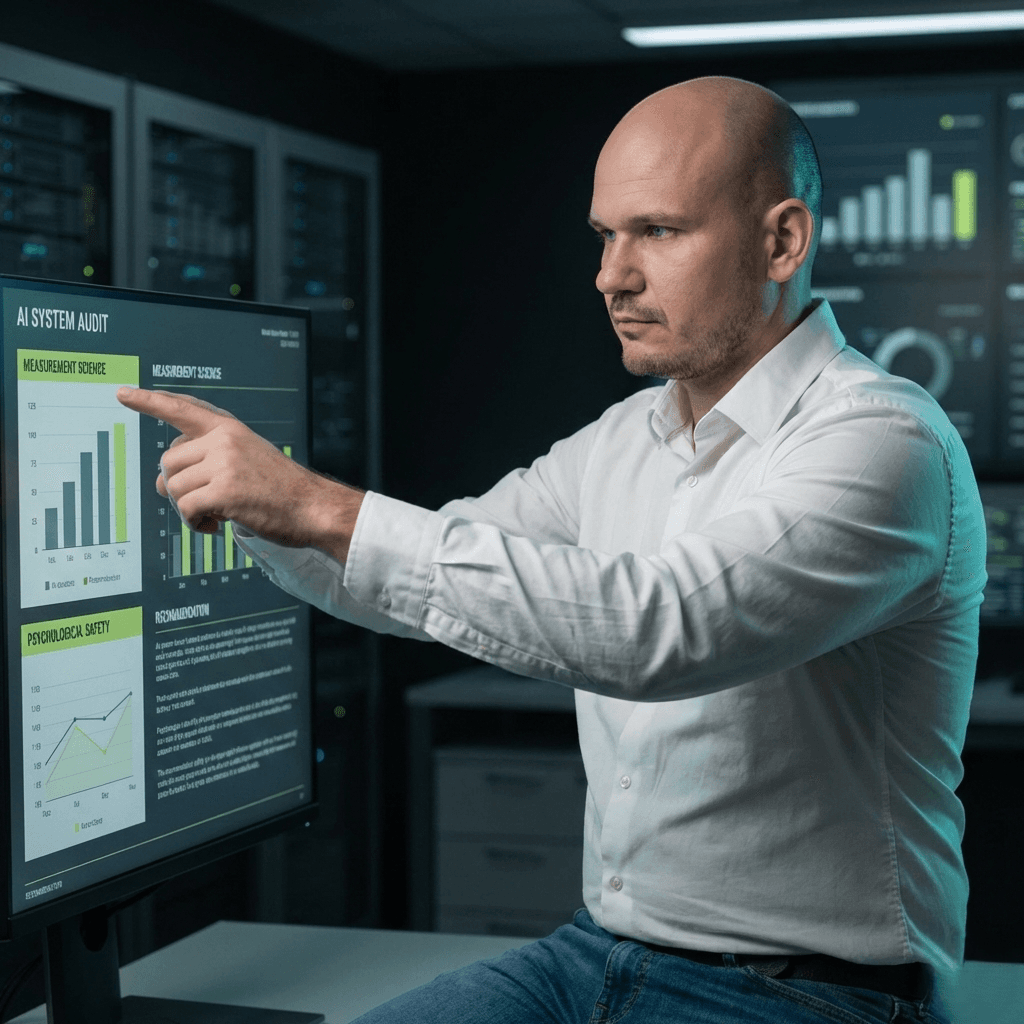
Map your system’s human impact, claims, and risk profile. Identify skill gaps by role across psychology, design, engineering, and governance.
Curriculum Tailoring
Hands-On Workshops
Assurance Simulation
Embed and Hand Over
Who This Is For
This service is designed for organisations and teams navigating the intersection of AI, people, and accountability.
Psychologists and Assessment Leads
Professionals supporting AI-mediated decisions who need practical evaluation skills.
Product Designers
Designers building high-trust and high-stakes user experiences with AI systems.
ML and Engineering Teams
Engineers deploying models into production who need psychometric literacy and governance skills.
Governance and Compliance Teams
Teams building internal AI controls and preparing for regulatory requirements.
Executive Leadership
Leaders who need a board-ready assurance narrative and decision discipline for AI systems.
Frameworks & Standards
Every engagement is anchored to recognised standards and frameworks for accountability and rigour.
Engagement model: 1 to 2 days for foundations for cross-functional teams. 3 to 5 days for full programme with system-specific labs and assurance simulation. Multi-cohort option for large organisations, with follow-up clinics for implementation support.
Ready to Get Started?
Let\u2019s discuss how this service can support your needs.